Pilot Training T-38
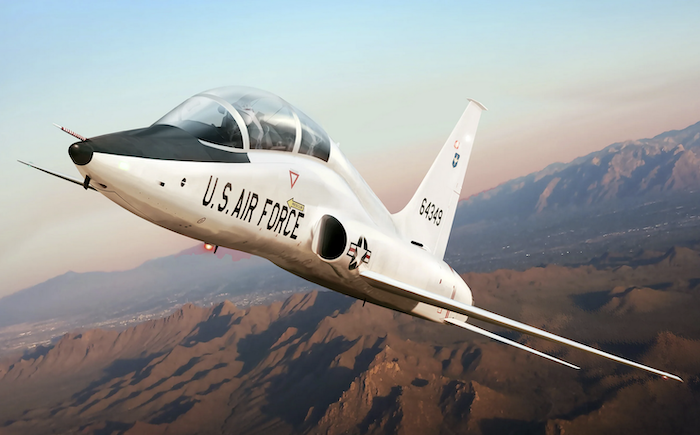
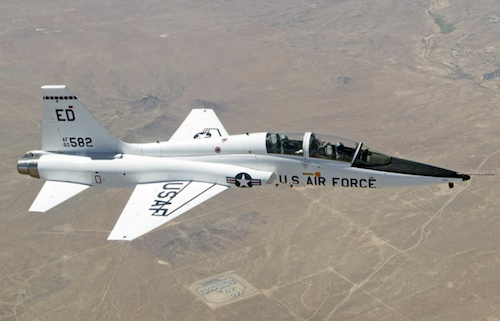
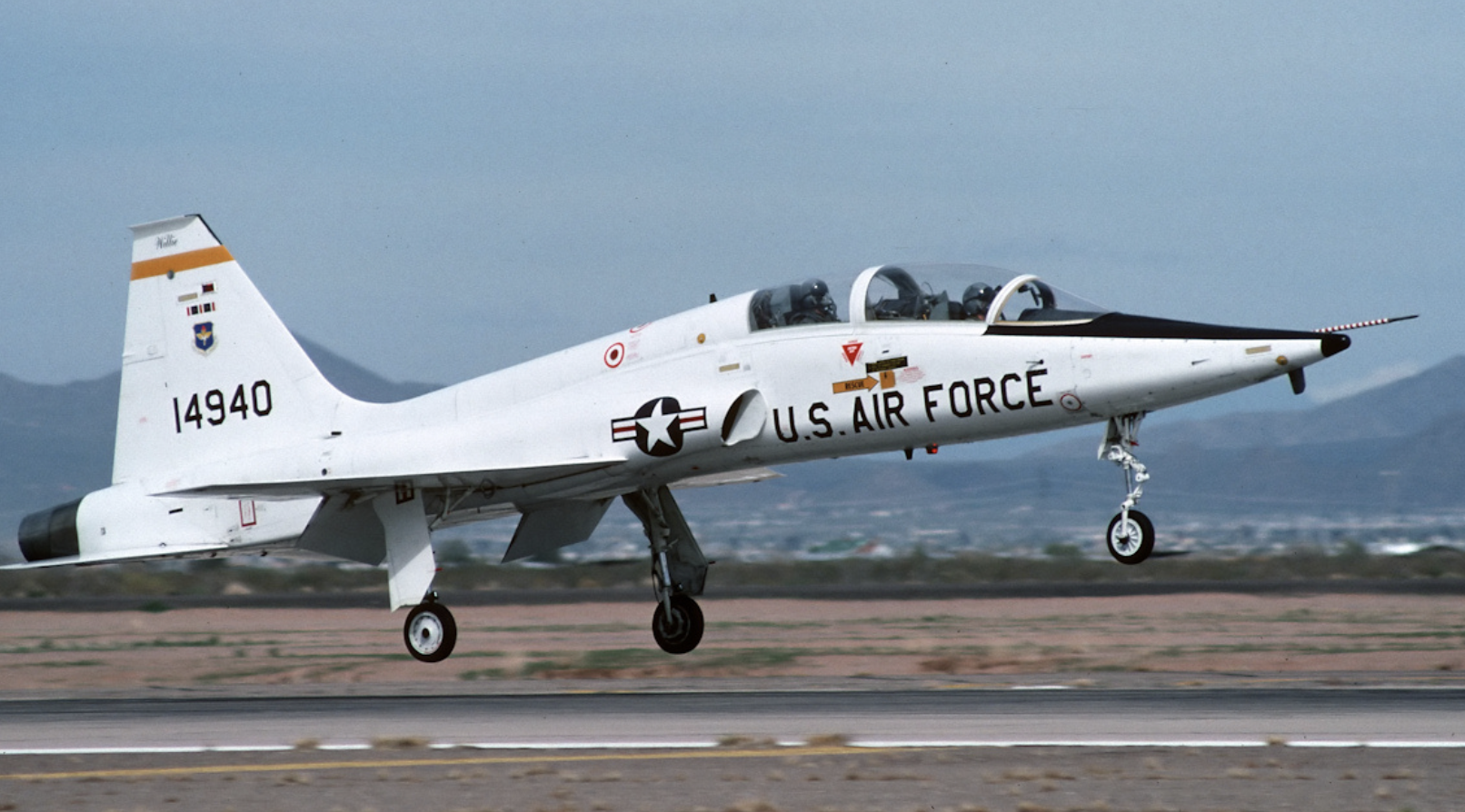
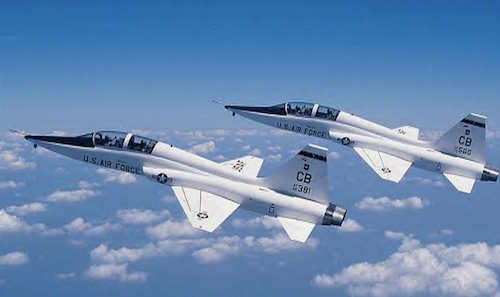
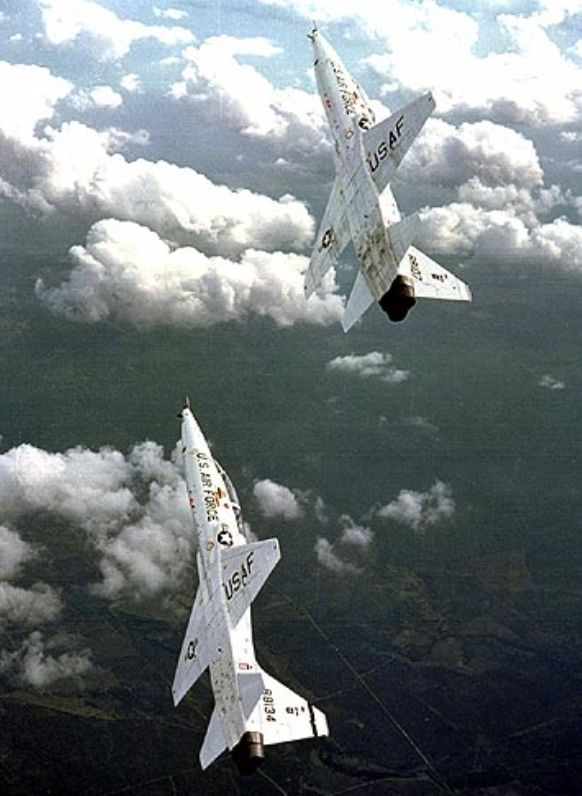
So after the T-37 portion of the training, we were going to move up to the White Rocket…the T-38 Talon. It has 2 jet engines with afterburner thrust, capable of Mach 1.3, or approximately 858 mph (1,381 km/h) at altitude, and tandem seating where the student usually sat in the front, and the instructor in the back.
It's hard to believe that the Talon was designed more than 40 years ago. Its tapered waist, razor thin wings and long, graceful fuselage are timeless design features, and it will always be a prototypical "fast jet" image in the minds of many airplane lovers.
During this time, though, I discovered that some of my ROTC buddies had washed out of T-37 pilot training at their particular basis. One of them, who I really respected and thought he would do very well, said he just couldn't make the final turn from downwind to the runway in his mind. Being a visual learner I had no problem with that but I had other issues, of course, as I've already relayed.
So all of the surviving students went onto the T-38 and into a new squadron and a whole new set of instructors.
Most of our academics were behind us, such as aerodynamics, weather, air traffic control procedures, Federal Aviation Administration (FAA) regulations, filing flight plans, and high/low level navigation.
We still had to memorize new Bold Face checklists and study the T-38 Dash one to understand the systems it had versus the T-37. And many flight simulators.
It would be good to note that in 1976 we had no full motion simulators. They were motionless and all you could see were the instruments to fly the jet.
An enlisted non-commissioned officer (NCO) ran the instructor panel and acted as air traffic control. He gave us some instructions according to an established curriculum which we knew in advance. I would study the routing and maneuvers the night before to be ready. Having a dad who was an NCO, I respected these men (men only in those days) and would usually chat with them afterwards. I found them to be bright, professional, and friendly…except one.
One of my least favorite moments in life was during my third simulator ride. The instructor gave me tasks that would overwhelm even an experienced IP and after it was over my confidence in being a pilot was shattered, and I was actually in tears coming out of the simulator. I looked over at the sergeant, who had a smug look on his face, and turned and walked out before the debriefing. As new as I was, it dawned on me that this was jealousy and a way to get back at officers. I had seen it in my own dad rarely, but I recognized it. He could have made a stink about my actions, but I think if it were found out what he was doing to the students he would lose that cherished position. I’m sure he flew the simulators better than any student and if that was all that there was to being a pilot his life would have been grand as a pilot.
Then on to the squadron to meet our IP and get grilled on airplane systems and Bold Face memory checklists.
Like the T-37 instructors, these IPs were polished, very good flyers. And like the T-37 flight squadrons, most of the IPs had been from other units as a pilot. Some were from fighters and some from heavies (cargo, tanker and bomber airplanes).My IP, Lt. Cosby, was what they called a FAIP, or first assignment instructor pilot, so he'd never been to another weapons system before. You don’t get that in T-38s unless you are an above average pilot and he had great hands.
The first time out to the jet you follow the IP around to see your first walk around. Every airplane has them. You look for leaks, tire wear, object in the intakes or exhaust ports, panels attached properly, paying special attention to the condition of the honeycomb-composite flight control surfaces and wingtips. The landing gear pins and pitot tube cover are stored in the fueling access panel below the left engine inlet, and the Angle-of-Attack (AOA) vane locking-device (about the size of your fist) is stored in the left-hand cockpit storage compartment. At this time, the grounding wire is unplugged from the nose and moved away from the airplane. Lt. Cosby loved flying and was very patient with me and I appreciated that.
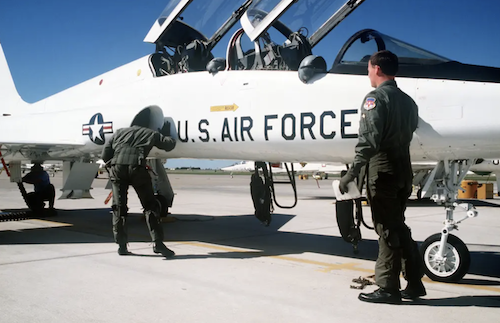
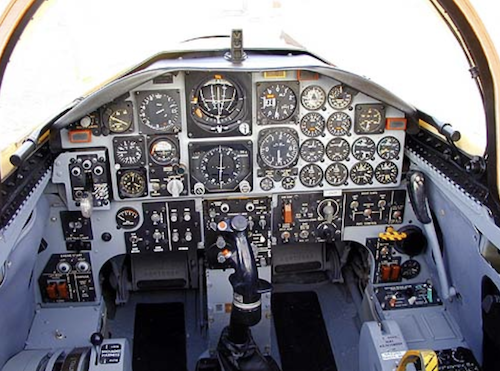
Except for instrument training rides, I sat in the front seat. Access to the T-38 cockpit is gained by a sturdy ladder that hooks over the edge of the canopy rail. After climbing up, you stow your in-flight publications and instrument approach plates in the map case on the right cockpit sidewall, then hang your helmet on the right canopy rail where it stays out of the way until you're strapped in.
Still standing on the ladder, you lean into the cockpit and turn on the battery, then check fuel and oxygen quantity, landing gear indicator lights, and cockpit warning lights. Because the exterior preflight involves bending and crouching around the aircraft, you remove your parachute and lay it on the ramp beforehand — both to protect it from damage and to avoid accidentally snagging the D-ring. The D-ring, when pulled, deploys the parachute. There were well-known stories among students of the particular embarrassment that followed when someone caught the ring on a piece of the aircraft and inadvertently set it off.
The excitement level begins to mount as you strap on your parachute and climb the ladder. You step onto the seat cushion, then you lower yourself into a sitting position in the small but comfortable cockpit.
The crew chief helps you strap in, connecting your G-suit while you thread the shoulder straps, crotch strap, and parachute.
After engines are started, you run through a series of flight control checks with the ground crewman. He insures that the control surfaces move the way they are supposed to, the main landing gear doors have closed, the speedbrakes close properly, and the horizontal stabilator moves to its proper takeoff setting. This completed, you check the flight instruments, cockpit indicators, and navigation gear. The ground crewman removes the wheel chocks on your signal, and it's time to taxi. Ground Control clears you for action.
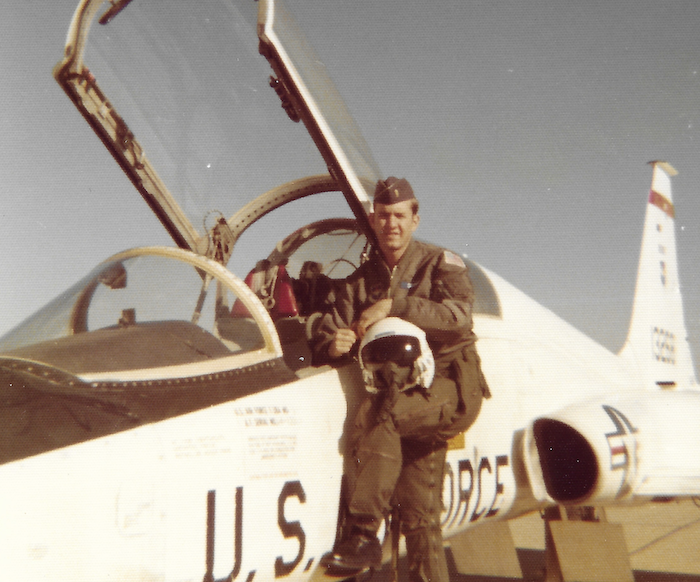
At the end of the runway, Tower clears me for takeoff. I reach up with my left hand, grab the edge of the canopy frame, lift it slightly, then pull it down as my right hand moves the sidewall-mounted locking lever forward. The canopy locks with a satisfying clunk, and the red Canopy light on the instrument panel goes dark. Almost immediately, I feel a subtle fullness in my ears as the pressurization system comes to life. Taxiing into position, I switch on the pitot heat and transponder and take a final check of the heading system. Now the fun begins.
I point the nose down the runway and let the aircraft roll forward slightly until the nosewheel is perfectly straight, then stop and pump the brakes a few times before standing on them with everything I've got. I push the throttles up to Military Power and wait for the engine instruments to stabilize. At MIL power, it takes real leg strength to hold the T-38 stationary, and after five seconds my legs are already starting to burn. A quick scan of the gauges — and it's time to go.
I release the brakes and shove the throttles past the MIL power detent and into afterburner in one motion. The aircraft lunges forward, slowly at first, then with a sudden kick as the burners light. Initial acceleration feels something like a high-performance sports car — but past 90 knots, the rate builds sharply. Remarkably, there is almost no engine noise in the cockpit. Through the takeoff roll I call out each critical airspeed in my head, each number a milestone toward flight. At 135 knots I begin applying back pressure to the stick. At 160 knots, the wheels leave the ground. The acceleration continues.
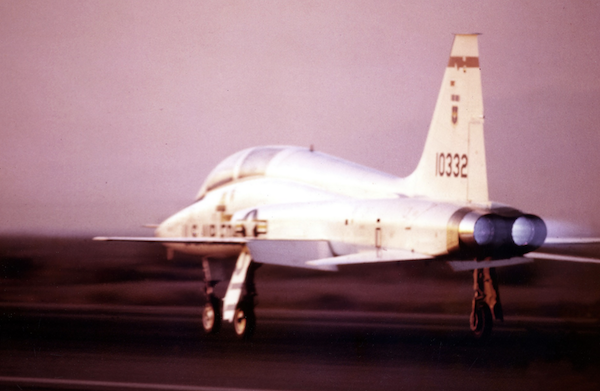
Immediately after liftoff, you raise the gear and flaps to avoid over-speeding them. More acceleration. 240 knots comes quickly, and you pull the engines out of afterburner, slowing the acceleration somewhat.
You keep the nose low, only 3 or 4 degrees high, until 300 knots, then raise the nose to 12 degrees to keep the speed at the 300-knot legal maximum below 10,000 feet. (The T-38 has a waiver to the FAA 250-knot limit for airplane speed below 10,000 feet.)
At this point the altimeter begins a rapid upward climb. On cold days, using only the normal non-afterburner climb schedule, I've observed a sustained climb rate of over 12,000 feet per minute for the initial portion of the climb. A full-afterburner climb at 300 knots results in a calculated initial climb rate of 30,000 feet per minute. At that rate, the altimeter needle spins one full rotation (1,000 feet) every two seconds.
The controls are well-harmonized and glass-smooth, responding to the slightest movement in a natural, pleasing way. Pitch forces are fairly heavy in the Talon, especially at higher G levels, but this trait helps to prevent inexperienced student pilots from over-"G"ing the airplane.
Once in our designated training area we do the planned maneuvers. Aileron rolls, barrel rolls, Immelmann, split S, loops, etc. All of this gives us confidence but also if we end up in an unusual attitude accidentally, we will know what to do to recover from it. Those were fun flights. We did not do spins.
During required airplane testing, test pilots put the T-38 into an intentional spin and found out it was unrecoverable. The pilots had to eject out of the plane.
I rarely got airsick either. It was smooth and fast. Then again, I knew I was going to volunteer for a B-52 so I would never see or do maneuvers like this again.
After about five or six flights with Lt. Cosby, I discovered that he would sometimes take landings that were supposed to be mine in the plan. He already had designated landings for himself in the curriculum but he said he needed the practice. The problem is that he would then log them under my name, so it appeared in the records that I had 4 or 5 more landings than I actually received. He said all of the instructors do it and that it was a compliment for me that my landings were so good already. I had concerns but I dreaded bringing it up to anyone else.
Now his other student was not doing so well. After 3 failed check rides (where we are tested on our proficiency) he had to go before a board of senior instructors called a Flight Evaluation Board (FEB). The board recommended that he be “washed out” of the program. The FEB process gives the student an opportunity to present their case, and there is typically a chain of command review before a final decision is made. It's a formal, documented process with significant consequences for the student's aviation career. Having nothing to lose, the student broke the news that Lt. Cosby had taken on some of his landings as well as some maneuvers but gave him credit in the official records.
The FEB then called me as a witness to ask me about Lt. Cosby’s actions with me. I let the board know what had happened as best as I could remember to include which flights it happened on. After leaving the board room I thought, “Well, this is it.” If it is true that instructiors do it all the time, as Lt. Cosby said, then I am going to wash out. It won’t be obvious, I will just fail ride after ride as retribution. Then head on to another career field and get out after my 6 year commitment is up. I felt at peace, oddly, knowing that God had greater plans than I did.
Again, God had a plan for me, and being a pilot was in the plan. I got a new instructor (thank you Jesus) and he was a former cargo plane pilot and knew I was going to ask for a B-52. I did not fail any flights with him. He was patient and professional. After a few flights he told me that the other pilots were very disappointed in Lt. Cosby and resented being accused of what he was doing. I flew with other IPs off and on and they were all fantastic.
About half way through we began instrument training. For these flights we flew from the back seat with a cloth cover over the cockpit window so we could not see out. It was drilled into us to continually crosscheck the instruments. On some occasions, the IP would have us close our eyes (on the honor system as he couldn’t see our eyes from the front seat, even though there were mirrors there). Then put us into an unusual attitude.
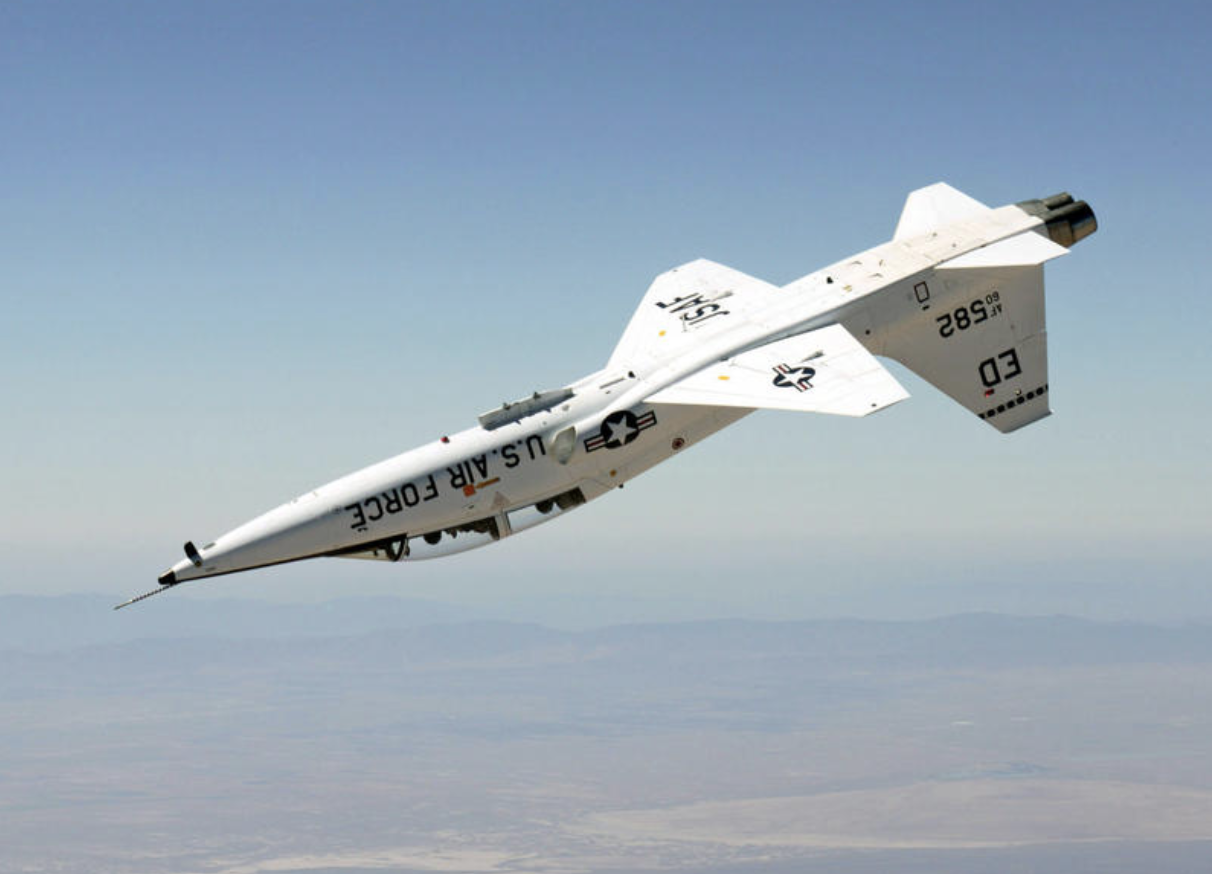
He would then say, “Recover.” I would open my eyes, look at my instruments and then return to straight and level flight.
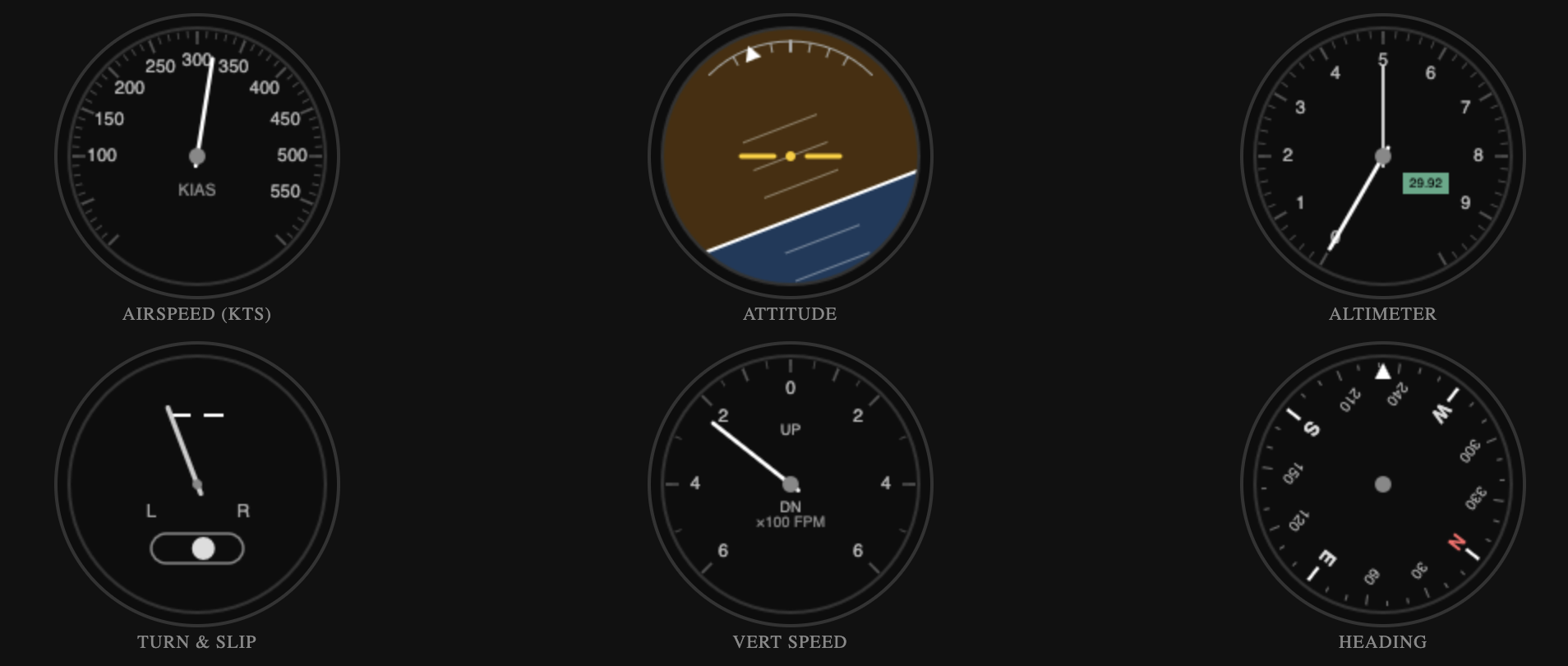
From that training, we had a saying. “One peek is worth a thousand cross checks.”
About half way through we also got to break the sound barrier on purpose. There were approvals needed that I never had to worry about. Going supersonic in a T-38 is surprisingly anti-climactic. You start at 32,000 feet, nose the aircraft into a 10-degree dive, and slam the throttles into afterburner. The nozzles swing open, the burners ignite, and the Mach window ticks upward: 0.91... 0.94... 0.97. The aircraft handles beautifully. The first real hint of breaking the barrier comes at Mach 0.98, when the bow wave sweeps past the pitot tube, causing the cockpit instruments to briefly twitch out of sync. Then, as you pass Mach 1.0, the stick stiffens slightly. That’s it. You are supersonic. There are no Hollywood special effects or sudden jolts—just a profound, quiet stillness in the cockpit as you streak through the sky.
I would end up doing two more accidentally while solo.
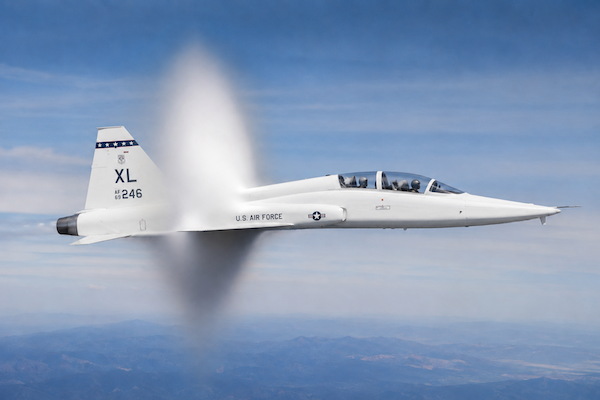
One of the most fun things to do was going Cross Country. Flying into military and civilian fields. We would grab breakfast or lunch, get refueled and head home. This got us proficient at flight planning, especially fuel, unfamiliar runways and airport traffic areas, flight navigation and so forth.
We had flown into Albuquerque International Airport, New Mexico, on a “cross country” flight. We were required to go to unfamiliar fields as part of the training. It also required closer fuel planning, navigation, timing, etc. Good stuff. This happened later in the program and I had probably 120 hours in the T-38 by then and felt pretty comfortable flying it.
Like most crews, we got there around lunch time and walked into a Fixed Base Operator (FBO) facility that had a nice little lunch counter. FBOs are privately owned with their own crew lounge, operations staff, and maintenance technicians who also handled refueling. We could use government funds if they weren’t already contracting with the FAA.
After lunch, the instructor pilot (IP) followed me around as I did the pre-flight check and got into the front seat (the IPs flew in the back for most missions). I got the engine start clearance, started those two beautiful and powerful engines, got clearance to taxi from the tower, and taxied to the active runway.
The tower kept hinting that they would like to see something fun as they were bored and the pattern was empty. So the instructor took the bait and asked for an “unrestricted climb” to our assigned altitude. It intrinsically meant we were cleared to go faster than the usual 250K below 10,000 feet altitude. And usually after we are cleared off of the tower frequency we contact departure control which then hands us off to FAA low sector radar, then to high sector. They went ahead and cleared us to the high sector frequency just after takeoff.
He let me do the takeoff, which is always using the afterburners (AB). Gear up, flaps up, then took the controls and we were about 50 feet above the runway. He leveled off and kept the throttles in AB. When we reached the end of the runway, we were at about 550 knots (we would break the sound barrier…highly frowned upon…at 570 knots).
At the threshold the IP pulled back hard and I was sucked back and down into the seat at around 4 to 5 G’s. So G’s are G-force and represent the amount of gravity that is pulling on a body. We all walk around daily at 1G. Zero G’s is weightless like astronauts in outer space. 2Gs your body weight is doubled, 3Gs tripled, etc.
A G suit is a piece of clothing that is worn over the flight suit like an extra pair of pants. It is hooked up to an air source that releases pressurized air into the bladders on the suit as pull on the G-force increases. My suit inflated as designed, pushing the blood in my legs up to my upper torso and into my brain pan so I would not pass out. The world did go a little gray and my vision went into a tunnel as I stared at the altimeter, telling me how high we were. The altimeter was what is now called a “round dial” instrument and the large 100 foot needle was spinning very quickly in a clockwise direction (a climb). The smaller needle representing thousands of feet was slower, but still pretty fast. Albuquerque is already at 5,000 feet above sea level, so the little needle passed through the 6 indication almost immediately followed by 7, 8, 9, etc…almost as fast as you can read it.
The T-38 does not have the same thrust as some fighters today that can actually accelerate in such a climb. Our airspeed bled off and at our assigned altitude of 29,000 feet we leveled off at a little below 200 knots (230 mph) all in about 60 seconds. What a rush!
Pilot training was designed to put pressure on the students to simulate a combat environment and weed out people who fold under pressure. So things like the unrestricted climb made pilot training exciting and fun.
Click the image above to see the unrestricted climb video.
Near the end of the program, all proficiency check rides were completed including an instrument check ride. We all knew we would pass as we went into the formation phase which had no check ride. It was so much fun! Again, knowing I would be flying a B-52 (I was the only one in my class that wanted one) I would ask my instructors in the preflight briefing if they wanted to fly formation. There was no requirement to log it. Each instructor I offered that to got excited and smiled.
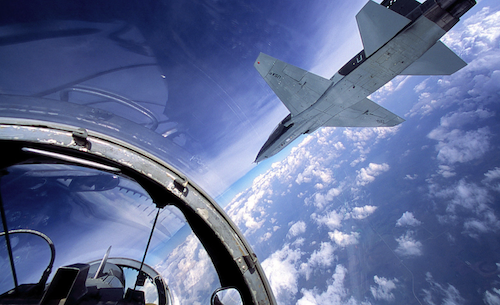
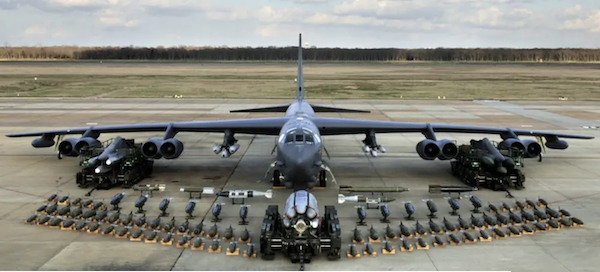
The day finally came that we could select the airplane we would go to fly next. Everyone in the class knew I wanted a BUFF (B-52) and sure enough, just one came down. This meant that no one would be assigned to a B-52 involuntarily. My classmates were so happy. Many offered me free beers they were so thankful.
The IP wasn’t that happy. They rate how good an instructor they are by the average number of engines they calculate for all of the students they get. The perfect instructor would have an average of ONE engine. Which at that time was only the F-16 fighter. Most fighters had two engines (F-15, A-10, F-4, etc.) The B-52, of course, has EIGHT engines and…well it takes a lot of single engine student assignments to bring that number down into an acceptable range.
But I was ecstatic. I had also asked for a Northern Tier assignment. The good news was that by Strategic Air Command (SAC) policy, once you were stationed at a Northern Tier base, you never would be reassigned to one involuntarily again. In SAC at the time this described a specific chain of United States Air Force installations positioned across the northernmost region of the continental United States.
Because the shortest flight paths between the Soviet Union and the United States stretched across the Arctic and the North Pole, these bases were geostrategically vital. Those bases were:
Minot AFB (North Dakota)
Grand Forks AFB (North Dakota)
K.I. Sawyer AFB (Michigan)
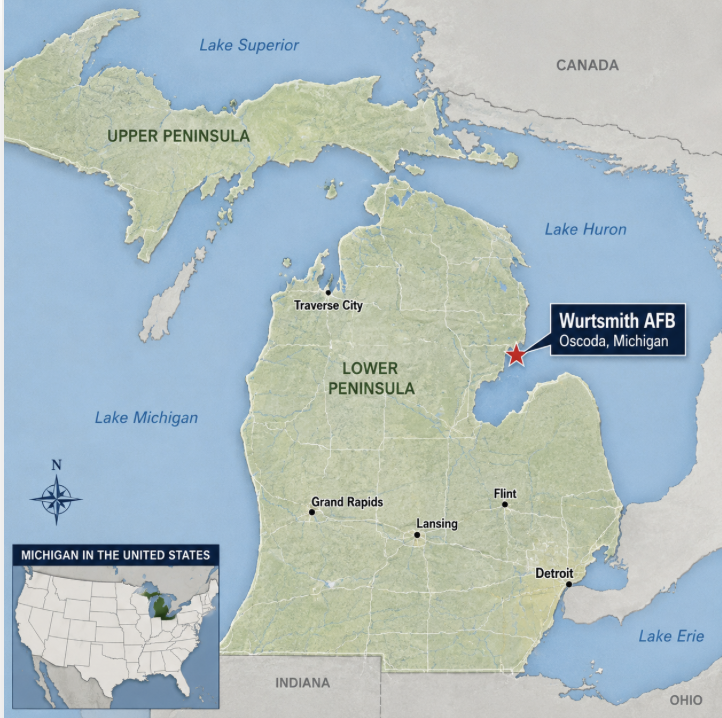
Wurtmith AFB (Michigan)
Loring AFB (Maine)
For the aircrews stationed there, the "Northern Tier" was synonymous with incredibly harsh, sub-zero winters, heavy snowfall, and relentless operational readiness inspections (ORIs). Keeping a fleet of heavy bombers and tankers fueled, maintained, and ready to launch in a North Dakota or Upper Michigan blizzard was one of the most grueling logistical challenges of the late Cold War.
I was assigned to Wurtsmith Air Force Base in Michigan. Because it was more remote, there were a lot more squadron socials where you got to know everyone and became a very tight nit organization. Two of my sons were born there and it was a great time overall.
On April 2, 1976, the day came that I looked forward to since my first days in college. I would get a pair of silver wings, representing the successful completion of Undergraduate Pilot Training. My wonderful wife (who put up with me for that year, helping me practice my memory items, watching me in wonder when I would sit with a plunger acting as a joy stick while I practiced flying maneuvers in the living room) pinned those cherished wings on my Class A uniform.
I will post some other stories on my flight history page, but this is the end of my pilot training stories. I hope you liked it. Please give me feedback in the form below. Thanks.